
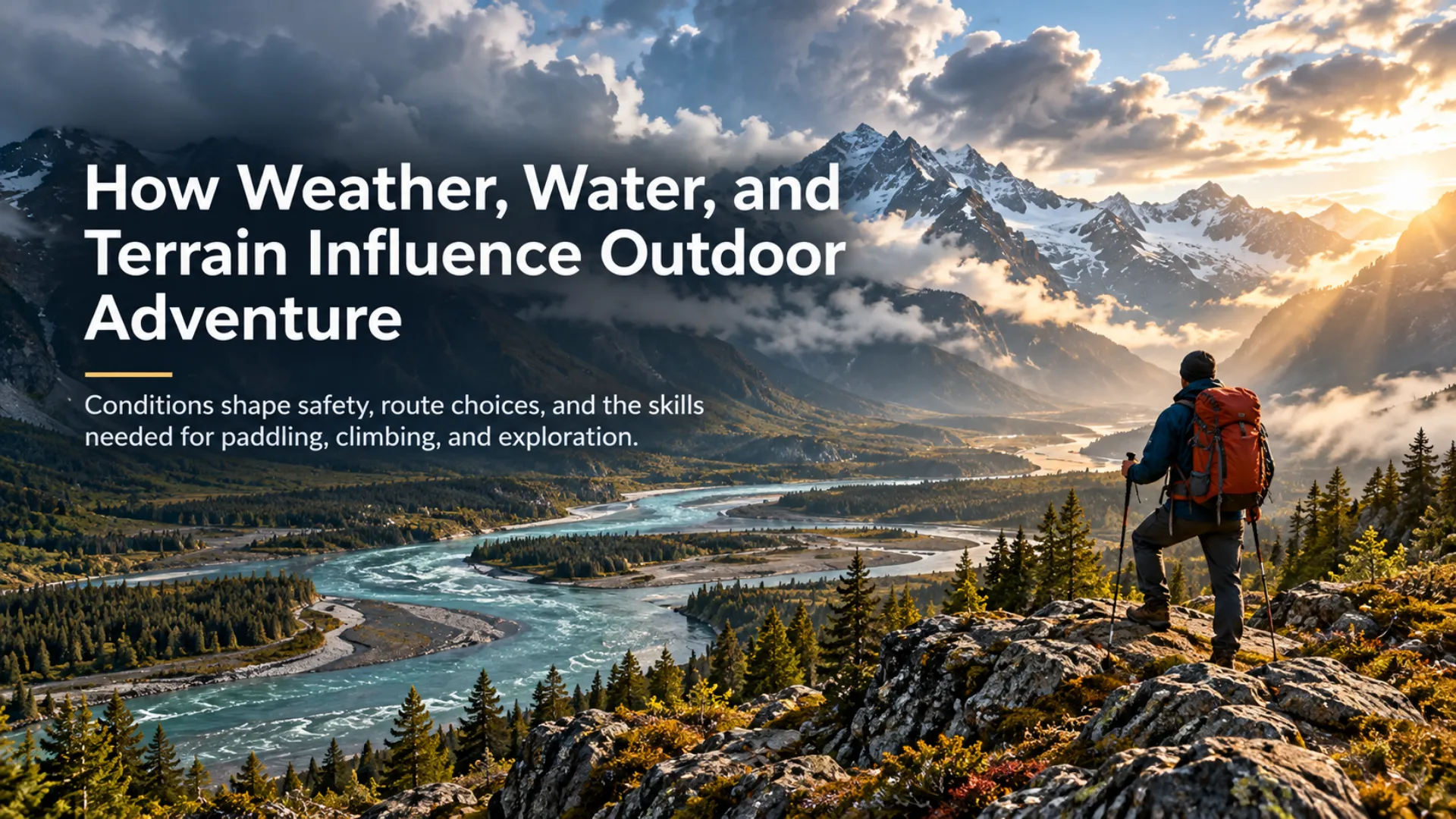
Outdoor adventure takes place in environments where conditions can change significantly over time. A quiet lake may become difficult to navigate when strong winds develop, while a familiar climbing route may present new hazards after heavy rainfall. Temperature, precipitation, water movement, and terrain characteristics all influence the challenges associated with outdoor activities. Understanding these natural factors is an important part of planning trips and choosing appropriate equipment. People who explore rivers, forests, cliffs, and mountainous areas benefit from recognizing that the same location can behave differently under changing conditions. Environmental awareness therefore plays a major role in responsible outdoor recreation.
Natural landscapes are not controlled environments, and their characteristics cannot always be predicted with complete accuracy. Weather forecasts, maps, route descriptions, and local observations provide useful information, but each has limitations. A forecast may describe regional conditions without capturing every change in wind or precipitation at a specific location. Similarly, a route that was accessible during one season may become more difficult after flooding, erosion, snowfall, or freezing temperatures. Outdoor participants must combine available information with observations made during the activity itself. This approach supports more informed decisions about whether to continue, change a route, or postpone an outing.
Why Local Weather Matters More Than a General Forecast
Weather is one of the most influential environmental factors affecting outdoor recreation. Wind direction and speed can alter paddling conditions, while precipitation can influence visibility, ground stability, and the behavior of waterways. Temperature is especially relevant because it affects clothing choices, physical comfort, and exposure-related risks. Mountainous regions may experience local weather variations caused by elevation, terrain, and the movement of air across slopes. Conditions observed at a nearby town or weather station may therefore differ from those encountered on a ridge, river, or exposed cliff. Understanding these differences helps explain why outdoor planning should consider location-specific conditions rather than relying only on a broad forecast.
Forecast information is most useful when it is evaluated alongside the planned activity and the surrounding environment. Paddlers should pay attention to wind, possible thunderstorms, and conditions that may affect waves or currents. Climbers should consider precipitation, temperature, and whether weather changes could affect their route or descent. Thunderstorms present particular hazards in exposed outdoor locations because lightning can strike well away from the heaviest rainfall. Weather patterns should also be monitored during an outing, since conditions can develop differently from those predicted earlier. Choosing to alter plans when the weather becomes unsuitable is an important part of sound outdoor judgment.
Understanding Moving Water and Cold-Water Exposure
Rivers and lakes contain physical conditions that may not be obvious from the shoreline. Moving water responds to channel shape, gradient, obstacles, and the volume of water passing through an area. On rivers, submerged rocks, fallen trees, and changes in current direction can create complex flow patterns. Water levels may rise following precipitation or snowmelt, sometimes affecting locations far from where the original weather event occurred. Even a relatively familiar waterway can present different challenges when its depth and flow change. For this reason, river conditions should be assessed according to current circumstances rather than previous experience alone.
Water temperature is another important consideration because immersion in cold water can affect breathing, coordination, and physical performance. A warm day does not necessarily mean that a lake or river has reached a comfortable temperature. Deep lakes, snow-fed rivers, and waterways affected by seasonal melting can remain cold even when surrounding air temperatures are mild. Sudden immersion may produce an involuntary gasp response and make controlled movement more difficult. Suitable flotation equipment, clothing selected for the water temperature, and a realistic rescue plan help address some of these risks. Recognizing the effects of cold water is an essential part of making informed decisions about paddling and other aquatic recreation.
Recognizing Hazards on Rock and Ice
Rock formations may appear solid and unchanging, but natural climbing surfaces can be affected by weathering, erosion, and temperature variations. Cracks can develop or expand over time, while loose stones may become dislodged by natural processes or human movement. Rain can reduce friction on certain surfaces and make footholds more difficult to use reliably. Water entering cracks may freeze and expand, contributing to mechanical weathering of the surrounding rock. These processes occur at different rates depending on the rock type, climate, and local geological conditions. Climbers should therefore avoid assuming that a route remains identical to its condition during a previous visit.
Ice presents additional challenges because its structure and strength can vary according to temperature and environmental history. Repeated freezing and thawing can alter the properties of natural ice formations. Flowing water beneath frozen surfaces may also influence their structure, even when the outer appearance seems relatively consistent. Sunlight, temperature changes, and precipitation can affect ice conditions throughout a day. Evaluating such conditions requires relevant knowledge and experience, particularly when technical climbing or exposure to steep terrain is involved. Visual appearance alone is not sufficient evidence that a natural ice feature is suitable for climbing or travel.
Matching Equipment to Real Outdoor Conditions
Outdoor equipment performs specific functions, and its suitability depends on the conditions in which it is used. A kayak intended for calm recreational water may not have the same handling characteristics as a boat designed for technical whitewater. Protective clothing must also be selected according to expected exposure rather than air temperature alone. Climbing equipment has its own requirements involving compatibility, correct use, inspection, and manufacturer recommendations. Selecting appropriate equipment is therefore a technical decision connected to both the environment and the participant’s abilities. Equipment that works well in one setting may be unsuitable for a different activity or level of difficulty.
Regular inspection is particularly important for items used in demanding outdoor environments. Abrasion, corrosion, ultraviolet exposure, and moisture can affect materials differently depending on their construction and intended purpose. Ropes, harnesses, helmets, flotation devices, and other safety-related equipment should be examined using the relevant manufacturer’s guidance. Certain forms of damage may be difficult to recognize without suitable knowledge or inspection procedures. Participants should also practice essential techniques before relying on equipment in challenging conditions. Appropriate equipment supports outdoor safety, but it cannot replace training, environmental awareness, or responsible decisions.
Better Group Decisions and Emergency Planning
Group activities introduce additional considerations because participants may have different levels of physical ability, experience, and confidence. A route that is manageable for one person may be too demanding for another member of the group. Fatigue can also influence coordination, concentration, and the ability to make decisions under pressure. Effective planning should take account of the least experienced participants and the likely demands of the environment. Clear communication about objectives, expected conditions, and possible changes to the plan can reduce confusion. Group members benefit from understanding the activity before entering areas where retreat or assistance may be difficult.
Emergency preparation should reflect the location, activity, and realistic availability of outside assistance. Remote outdoor areas may have limited mobile coverage, difficult access, or long response times for rescue services. A trip plan can include the intended route, expected return time, emergency contacts, and procedures for unexpected delays. Participants should also consider whether they have appropriate first-aid knowledge and supplies for their activities. Establishing practical turnaround points can help groups avoid continuing into increasingly difficult conditions simply because they have already invested time in a route. Good emergency planning focuses on reducing preventable problems while acknowledging that not every situation can be controlled.
Protecting Natural Places While Exploring Them
Outdoor recreation takes place in landscapes that support plants, animals, and ecological processes. Repeated human activity can influence these environments through soil compaction, vegetation damage, erosion, and disturbance to wildlife. The effects may be particularly noticeable in heavily visited locations or areas with fragile vegetation. Wet ground and steep slopes can be vulnerable to additional erosion when visitors create informal paths. Rivers and lakes may also be affected by litter, pollution, and the movement of invasive organisms between waterways. Understanding these impacts helps outdoor participants recognize that their choices can influence the condition of the places they visit.
Responsible recreation involves following applicable access rules and adapting behavior to the sensitivity of the environment. Staying on established paths where appropriate, disposing of waste correctly, and avoiding unnecessary disturbance can help limit human impacts. Cleaning and drying relevant equipment between waterways can also reduce the risk of transferring certain aquatic invasive species. Wildlife should be observed without approaching, feeding, or disrupting normal behavior. Local restrictions may exist to protect nesting birds, sensitive habitats, or areas undergoing environmental restoration. By combining environmental awareness with practical outdoor skills, visitors can contribute to the continued enjoyment and protection of natural landscapes.